
How to Reach Out to Research Labs (and Actually Get a Response): A Practical Guide for High School Students
Mar 17, 2026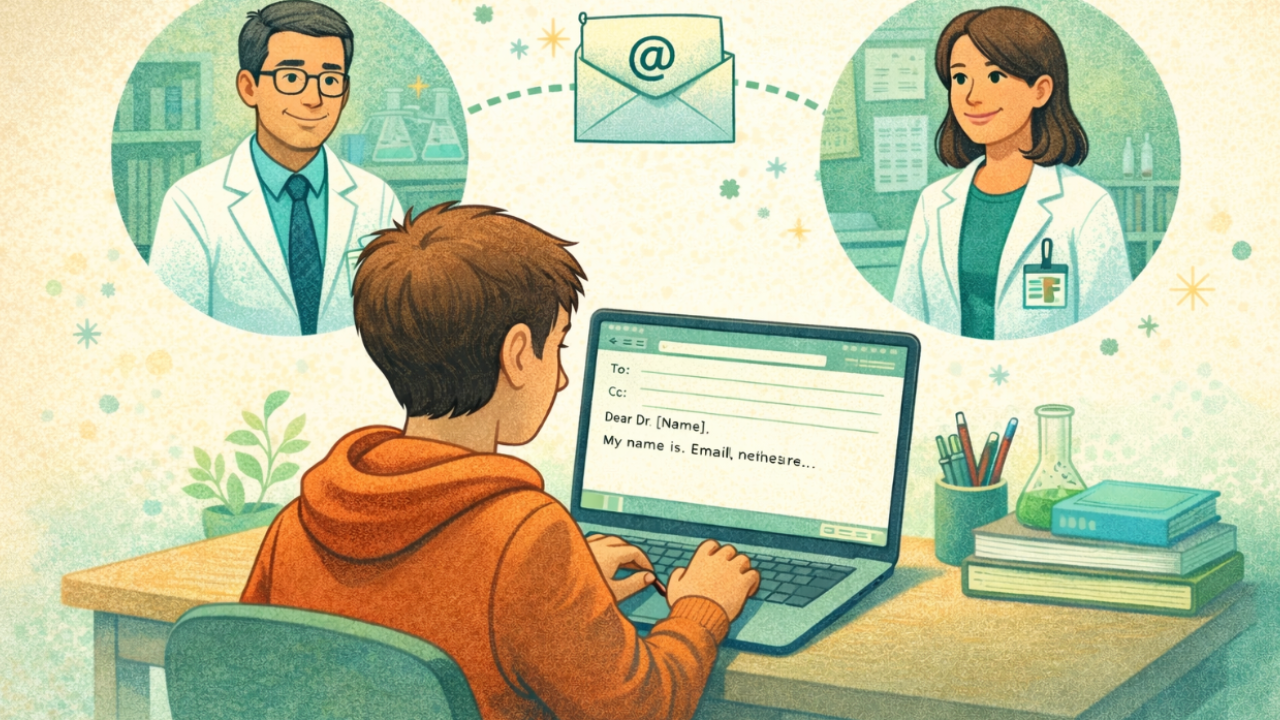
You’ve found a lab that genuinely interests you.
That’s huge.
Now comes the part that makes most students nervous:
reaching out.
The good news?
This isn’t about having the “perfect” résumé or knowing the right people.
It’s about being clear, respectful, prepared, and honest.
This post will walk you through exactly how to do that.
Step 1: Figure Out Who to Contact
Most labs are run by a Principal Investigator (PI), usually a professor or physician-scientist. But they are also supported by people who help manage the lab day-to-day.
When possible, look for two types of contacts:
1. The Principal Investigator (PI)
This is the person whose name is on:
- The lab website
- Most of the papers
- The “Lab Director” or “Faculty” page
Their email is often listed on:
- University faculty pages
- Department websites
- Published papers (look under “corresponding author”)
2. The Lab Manager or Administrative Assistant
This person may be listed as:
- Lab manager
- Research coordinator
- Administrative assistant
- Program coordinator
They often:
- Help schedule students
- Know what opportunities exist
- Respond faster than the PI
If you can’t find both, start with the PI. That’s completely okay.
Step 2: Understand the Goal of Your First Email
Your first email is not:
- A job application
- A demand for a position
- A full life story
Your goal is simple:
Introduce yourself, show genuine interest, and ask if there might be an opportunity to learn.
That’s it.
Step 3: The General Structure of a Strong Outreach Email
A good research email has five clear parts.
1. Brief Introduction
Keep this to 1–2 sentences.
Include:
- Your name
- That you’re a high school student
- Where you go to school (optional but helpful)
Example:
“My name is ___, and I’m a high school student at ___ in ___. I’m very interested in learning more about ____ research.”
2. Be Specific About Why Their Research Interests You
This is the most important part.
Avoid:
- “I love science”
- “Your research is very interesting”
- Copy-pasted praise
Instead:
- Mention one specific topic, method, or question
- Show you actually looked at their work
Examples:
“I was particularly interested in your lab’s work on immune responses in cancer, especially your recent focus on tumor microenvironments.”
or
“I read about your research on brain imaging and decision-making, and I was curious about how these methods are used in real clinical studies.”
You don’t need to sound advanced. Just thoughtful.
3. Explain That You Are Local and Looking for a Longitudinal Experience
Labs prefer students who:
- Are nearby
- Can commit over time
Be clear and honest.
Example:
“I live locally and am hoping to find a longitudinal research experience where I can learn and contribute consistently over time.”
4. Be Specific About Availability (Without Overcommitting)
This part matters more than students realize.
Bad:
- “I can work anytime”
- “I’ll do whatever is needed”
Good:
- Clear, realistic availability
Example:
“During the school year, I would be available approximately 5–8 hours per week, and during the summer I could increase my availability to 9-5 daily. I am hoping to commit for at least ___ months.”
Never overcommit. Labs respect honesty much more than exaggerated availability.
5. Briefly Mention Any Relevant Experience or Training
You do not need prior lab experience.
But you can mention:
- Coursework
- Workshops
- Bootcamps
- Independent projects
- Skills you’re learning
Keep it short. Attach a neat and succinct resume.
Example:
“I have completed introductory coursework in biology and have been building foundational skills in research methods and data analysis.”
Step 4: What You Shouldn’t Do
Avoid:
- Writing a very long email
- Attaching lots of documents unless asked
- Claiming skills you don’t actually have
- Sounding desperate or apologetic
You are reaching out as a learner, not begging for a favor.
Step 5: If You Don’t Hear Back
This is normal.
Researchers are busy.
If you don’t hear back after:
- 10–14 days
It’s okay to send one polite follow-up.
No response ≠ rejection
Silence ≠ failure
All it takes is one yes.
A Note on Preparation and Confidence
Many students worry they aren’t “ready” for research yet.
That’s understandable.
Having foundational exposure to:
- Bench research
- Clinical research
- Reading papers
- Making figures
- Understanding how research actually works
…can help you feel more confident and show labs that you are serious about learning.
At Research Skills, we run research bootcamps designed to help students:
- Build comfort with bench and clinical research
- Learn how studies are designed and run
- Create publication-quality figures
- Gain experience that can support future research opportunities
- Participate in projects that lead to papers and presentations
For students preparing to reach out to local labs, this kind of training can make it easier to demonstrate readiness and curiosity.
The Big Picture
Reaching out to labs isn’t about saying the “perfect” thing.
It’s about:
- Being respectful
- Being specific
- Being honest
- Being prepared to learn
- Reaching out to enough labs to get at least one response