
How Tiny “Y-Shaped” Proteins Changed Medicine Forever
Mar 17, 2026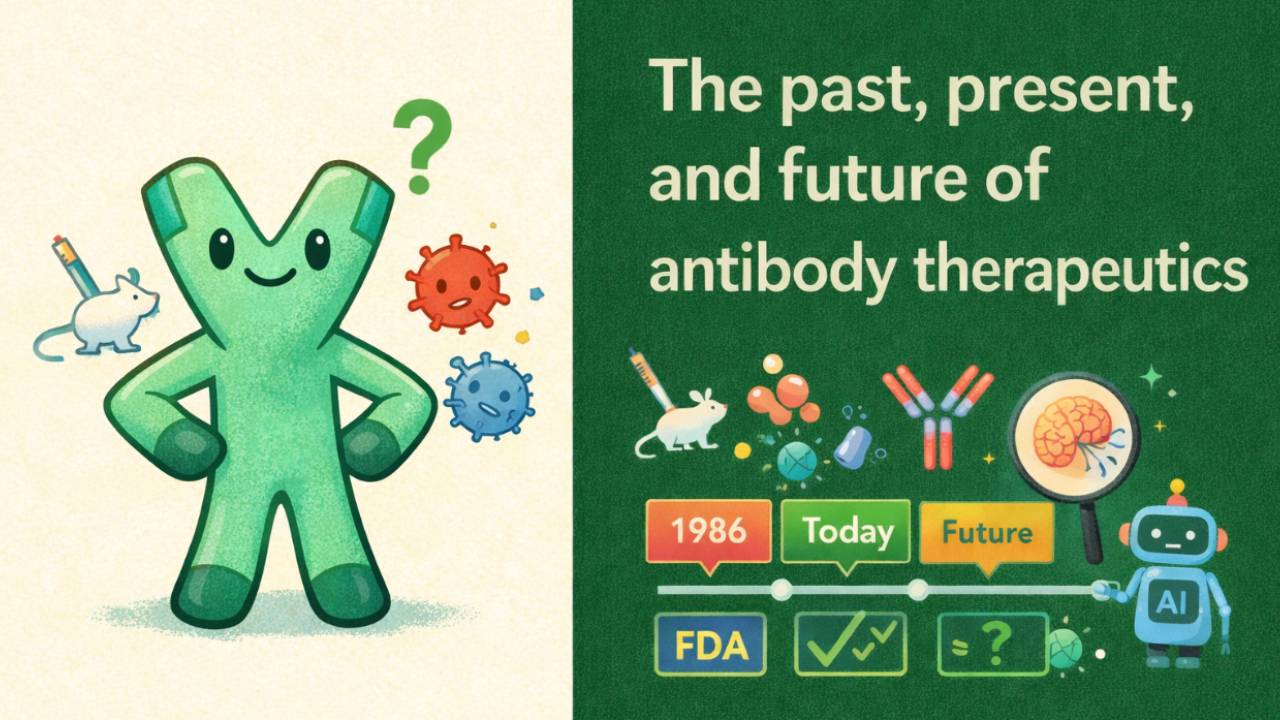
Imagine if your body had smart missiles—tiny tools that could recognize a virus, a cancer cell, or a harmful molecule and take action with incredible precision.
Good news:
You already do. They’re called antibodies.
And for the past 50 years, scientists have learned how to turn these natural defenders into some of the most powerful medicines ever created.
Let’s break it down.
First: What Is an Antibody?
Antibodies are proteins made by your immune system. Their job is simple:
Find something dangerous → bind to it → help stop it.
They’re shaped like a Y, and the tips of the Y are super specific. One antibody might bind only to a flu virus. Another might recognize a cancer cell. It’s like a lock-and-key system.
For a long time, scientists wanted to use antibodies as medicines…
but they didn’t know how to make just one kind at a time.
That changed everything in 1975.
The Big Breakthrough: Making “Monoclonal” Antibodies
In 1975, two scientists discovered a way to make monoclonal antibodies—which means:
One type of antibody that targets one specific thing.
This technique (called hybridoma technology) let scientists produce unlimited copies of the same antibody in the lab.
Why was this huge?
Because now doctors could:
- Target cancer cells without harming healthy ones
- Calm overactive immune systems
- Treat infections more precisely
This discovery was so important that it won a Nobel Prize 🏆.
A hybridoma is one of those brilliant “what if?” ideas that completely changed medicine. Scientists knew that B cells in the immune system are incredibly good at making antibodies, each B cell produces one very specific antibody that targets one exact threat. The problem? B cells don’t survive very long outside the body. Meanwhile, cancer cells can grow forever in the lab, but they don’t make useful antibodies. So researchers asked a bold question: what if we fused the two? The result was the hybridoma, a hybrid cell made by combining an antibody-producing B cell with an immortal myeloma (cancer) cell. This new cell has the best of both worlds: it knows how to make one precise antibody, and it can keep doing so endlessly. Scientists can then grow that single hybridoma into millions of identical cells, all producing the exact same “monoclonal” antibody. It’s like finding one perfect key and then building a factory that makes that key over and over again with zero mistakes. This simple but powerful idea turned antibodies from a natural immune response into a tool scientists could design, mass-produce, and use to treat diseases ranging from cancer to autoimmune disorders, and it all started with one fused cell in a lab.
From the Lab to the Hospital
At first, antibody medicines had problems:
- They didn’t last long in the body
- The immune system sometimes attacked them
- They weren’t always strong enough
So scientists improved them.
Over time, antibodies were:
- “Humanized” (made to look more like natural human antibodies)
- Engineered to work better and last longer
- Mass-produced safely and consistently
Today, there are 200+ antibody-based medicines used around the world, helping millions of patients.
|
Antibody (Brand) |
Year Approved |
Disease Treated |
Why It Was Innovative |
|
Muromonab-CD3 (OKT3) |
1986 |
Organ transplant rejection |
First FDA-approved monoclonal antibody, proving antibodies could work as medicines |
|
Rituximab (Rituxan) |
1997 |
Blood cancers (lymphoma) |
One of the first antibodies to target cancer cells specifically, sparing many healthy cells |
|
Trastuzumab (Herceptin) |
1998 |
HER2-positive breast cancer |
Helped launch personalized medicine by treating only patients with a specific tumor marker |
|
Adalimumab (Humira) |
2002 |
Rheumatoid arthritis, Crohn’s disease |
First fully human antibody, reducing immune side effects |
|
Bevacizumab (Avastin) |
2004 |
Multiple cancers |
Blocked blood vessel growth that tumors need to survive |
|
Pembrolizumab (Keytruda) |
2014 |
Melanoma, many cancers |
Unleashed the immune system via checkpoint inhibition, changing cancer treatment |
|
Aducanumab (Aduhelm) |
2021 |
Alzheimer’s disease |
First antibody approved to target amyloid plaques in the brain (controversial but historic) |
Antibodies Today: More Than One Trick
Modern antibody medicines can do way more than just “stick” to something.
Here are some cool examples:
🧲 1. Targeting Cancer
Some antibodies lock onto cancer cells and:
- Mark them so immune cells can destroy them
- Block signals cancer cells need to grow
💊 2. Antibody–Drug Conjugates (ADCs)
These are antibodies carrying tiny doses of powerful drugs.
Think of them like:
Delivery drones that drop medicine directly onto cancer cells.
This reduces side effects and increases effectiveness.
🤝 3. Bispecific Antibodies
These antibodies can bind two things at once.
Example:
- One end grabs a cancer cell
- The other grabs an immune cell
- Brings them together so the immune cell can attack
Pretty clever, right?
Making Treatment Easier for Patients
Antibody medicines are also becoming:
- Easier to take (some are injections instead of long IV treatments)
- Longer-lasting (patients need fewer doses)
- More personalized
All of this improves quality of life—not just survival.
The Future: Antibodies + AI 🤖🧠
The next wave of antibody medicine is just getting started.
Scientists are now using:
- Artificial intelligence to design better antibodies
- New formats that can reach the brain or be taken orally
- Antibodies that help guide immune cells directly
The goal?
Smarter, faster, safer treatments for more diseases.
Why This Matters for You
If you’re interested in:
- Biology
- Medicine
- Engineering
- AI
- Helping people through science
Antibody research sits right at the center of it all.